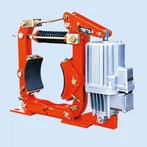
Due to the periodic and intermittent working characteristics of the crane, each working mechanism is often in a state of frequent starting and braking. The brake becomes an indispensable part of each mechanism of the power-driven crane. It is not only the control device of the mechanism but also the guarantee of the crane Safety device for operation. Whether the brake is intact and reliable is the focus of safety inspection.
The essence of the brake is to produce a braking effect through the friction of the friction pair. According to the needs of the work, or convert the kinetic energy of the movement into frictional heat energy consumption to stop the mechanism; or balance the force through the static friction force to keep the mechanism at the original static state.
The structural features are: one group of brake friction pairs is connected to the fixed frame; the other group is connected to the rotating shaft of the mechanism. When the friction pair contacts and presses tightly, a braking effect occurs; when the friction pair separates, the braking effect is released and the mechanism can move.
1. The function of the brake
(1) Support function: keep the original stationary object at rest. For example, in the hoisting mechanism, the hoisting weight is kept still in the air; in the luffing mechanism of the jib crane, the jib is maintained at a certain position to remain stationary; it plays a wind-proof and anti-skid role on the outdoor crane.
(2) Stopping effect: The kinetic energy of the moving part is consumed and converted into frictional heat energy by the friction pair, so that the mechanism stops the movement quickly within a certain time or within a certain stroke. For example, the braking of various mechanisms in motion.
(3) Falling weight effect: The braking force is balanced with gravity to make the moving body drop at a stable speed. For example, truck cranes travel at downhill speeds.