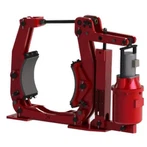
Key Performance Comparison
|
Aspect |
YT1 Series (legacy) |
ED Series (upgraded) |
Practical impact |
|---|---|---|---|
|
Operating frequency |
Up to 600–720 cycles/h |
900–2000 cycles/h |
ED suits high-duty European-style cranes (A5–A7); YT1 overheats and ages fast under frequent starts/stops |
|
Mounting orientation |
Mostly vertical only (rod up); horizontal mount risks leakage |
0–180° any angle thanks to balanced air chamber, no oil leak |
ED fits tight/non-standard brackets; YT1 must stay vertical |
|
Enclosure / protection |
Cast iron, IP54, Class B insulation |
Aluminum alloy, fully sealed, IP65, Class F insulation |
ED resists rain, dust, heat; longer motor life outdoors / in steel mills |
|
Duty type |
Short-time S2 dominant |
S1 continuous / S3-60% intermittent |
ED can stay energized (hold-release) longer; YT1 burns out if held on |
|
Response time |
Slower rise/fall (e.g. YT1-45Z/6 ≈ 0.7 s rise) |
Faster & smoother (e.g. Ed50/6 ≈ 0.45 s rise) |
ED gives quicker, steadier braking for precise positioning |
|
Weight / power |
Heavier cast iron, slightly higher wattage per thrust |
30–40% lighter aluminum, lower noise, lower power draw at same thrust |
Better for trolley drives and energy-saving retrofits |
|
Oil filling |
Shipped dry, user fills oil on site |
Factory-filled, double-sealed, chrome-plated rod/shaft |
ED avoids "no-oil burn" errors; seals last longer |
|
Brake compatibility |
YWZ, YWZ4, YWZB legacy frames |
YWZ5, YWZ9, YPZ2, BYWZ5 (explosion-proof) |
Mixing thruster across brake families needs hole-pattern check |
|
Explosion-proof option |
BYT1 exists but old-style |
BEd mature flameproof variant |
Hazardous areas use BEd directly, not plain ED |

Differences in Actuation Speed
Under the same thrust rating, ED models offer shorter and smoother rise/fall times (e.g., Ed50/6 rises in about 0.45s, while YT1-45Z/6 takes around 0.7s), with a half-beat faster braking response, providing greater stability for lifting mechanisms requiring high positioning accuracy.
Hard Constraints When Replacing
Thrust and stroke must match exactly by grade (e.g., YT1-45Z/6 ≈ Ed50/6, YT1-180Z/12 ≈ Ed201/6); do not assume compatibility based solely on similar housings.
Mounting hole spacing and center height must be measured in practice: YT1 and ED base dimensions are not fully interchangeable; replacing old YWZ4 units directly with ED often requires an adapter plate or replacement of the entire brake assembly.
The only remaining advantages of YT1 are low cost and easy availability of spare parts-suitable for maintaining older, light-duty, low-speed equipment. For new designs or high-frequency applications, there is no need to choose YT1 anymore.
In short-YT1 is "usable," while ED offers "durability + high frequency + flexible installation." For maintenance of legacy lines where convenience matters, keep YT1; for new installations or reducing failure rates, go straight for the equivalent ED model.