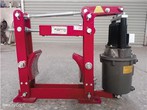
Six Warning Signs Indicating Brake Repair
Brake Failure or Hook Slippage
When the operator finds that the load continues to slide down after the crane handle has been returned to the zero position, and the sliding distance exceeds 1/100 of the rated lifting speed (e.g., at a speed of 8m/min, the sliding distance exceeds 80mm), this is a typical "hook slippage" phenomenon.
Main Causes: Severe wear of braking components, air or hydraulic system malfunction, damaged electromagnetic coil, etc. Brake pads must be replaced when wear reaches 50% of their original thickness; when wear exposes the rivets, they must be replaced immediately.
Insufficient Braking Force and Excessive Braking Distance
Poor braking performance manifests as insufficient braking force and excessive braking distance. This is caused by excessive clearance between the braking elements and rotating parts, surface contamination or aging of the braking elements, insufficient pressure, etc.
Inspection Method: Regularly check that the clearance between the brake band and the brake wheel is 1-2.5mm, and the clearance between the brake pads and the brake wheel is 0.25-1mm, with uniform clearance on both sides.
Brake Overheating or Burning Odor
An abnormally high brake temperature accompanied by a burning odor is an extremely dangerous sign. This is usually caused by excessive friction between the braking elements and rotating parts, cooling system failure, or prolonged continuous braking.
Possible Causes: Improper brake installation and adjustment, resulting in the brake pads not completely disengaging from the brake wheel after release, causing continuous friction.
Abnormal Noise During Braking
A harsh or abnormal noise during braking usually indicates loose braking elements, impurities in the air or hydraulic system, or an imbalance in rotating parts. A rough working surface of the brake wheel can also cause this problem, requiring machining.
If the brake cannot open or operates slowly, it may be due to a jam in the transmission system, a sluggish impeller in the hydraulic actuator, or a stuck hinge point in the brake frame.
Solution: Clear the jamming, check the lubrication, and replace damaged parts if necessary.
Visible Component Wear or Damage
The following conditions, observed during regular inspections, indicate the need for brake maintenance:
• Brake wheel surface wear reaches 2-3mm, or surface defects such as cracks or deep grooves.
• Springs show plastic deformation, cracks, scratches, or corrosion.
• Pin or shaft hole diameter wear reaches 5% of the original diameter.
Daily Inspection and Maintenance Points
To ensure the brakes are always in good condition, the following daily inspections are recommended
Per-shift inspection
(for hoisting mechanism brakes)
Check for jamming and wear at hinges, and for looseness at all fasteners; check the wear and cleanliness of the brake wheel and brake band.
Daily inspection
(for traveling mechanism brakes)
Check for normal operation of all moving parts and the normal functioning of the hydraulic system.
Regular maintenance
According to the crane's maintenance cycle, conduct a comprehensive overhaul of the brakes periodically, checking the lubrication level to ensure normal operation.
For the following situations, it is recommended to contact a professional maintenance technician immediately instead of attempting to handle the issue yourself

01
Complete brake failure
02
Severe brake overheating
03
Obvious shaking or deviation during braking
04
Increased brake pedal travel or significantly reduced braking force

Important Reminder: The brake is a core safety device for cranes; any abnormality should be addressed promptly. For operators without sufficient experience, it is essential to contact the equipment manufacturer or a professional maintenance technician for inspection to ensure safe equipment operation.
Regular inspection and timely maintenance of the brakes are not only necessary to ensure the normal operation of the equipment but also a responsibility to the safety of operators and company property. Safety is paramount; even the slightest negligence can lead to irreparable losses.
If you have any questions about the condition of your brakes, please consult a professional technician for targeted inspection and maintenance advice.
Our production and equipment
Our free service hotline:+8615516609555

23
years
We have been working in the industry since 2002
32
certificates
We have obtained most of the professional certificates in the industry and insist on international standards of production.
18
awards
We have won a lot of awards for strong creativity