


Why is brake failure so dangerous?
Industrial brakes are key devices that slow down, stop or keep moving parts stationary through friction, hydraulic or electromagnetic forces. Taking a crane (bridge crane) as an example, the brake of its lifting mechanism needs to convert the torque of the high-speed motor into static friction within 0.1-0.3 seconds. If it fails, the suspended heavy objects (such as tons of steel, large molds) may fall out of control in an instant; for example, conveyor belts, winches and other equipment, brake failure will cause material accumulation, equipment collisions and even overturning of the entire machine.
What's more serious is that brake failure is often accompanied by suddenness - it may be wear of mechanical parts (thin brake pads), leakage of the hydraulic system, electrical control failure (such as coil burnout), or the operator failed to detect the abnormality in time. Once a failure occurs, the operator may have less than a few seconds to react. If there is no plan, the consequences will be disastrous.
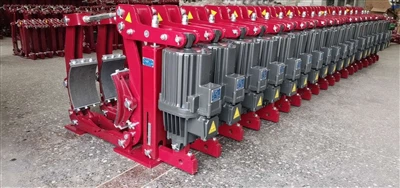
Emergency operation guide in different scenarios
According to the characteristics of different industrial equipment, emergency measures for brake failure need to be "appropriate". The following are the key points for handling common scenarios (note: the premise of all operations is to ensure that personnel quickly evacuate the dangerous area)!
① Driving/crane type: heavy object suspension failure
Prioritize the failure type: If the lifting mechanism brake fails (such as a sudden drop of a heavy object), the "multiple braking" strategy must be implemented immediately.
Step 1: Use motor reverse braking (only for winding motors): Quickly press the controller reverse button (such as "down" to "up"), and generate reverse braking through the motor reverse torque (principle: use electromagnetic force to drag the rotor and reduce the falling speed). At this time, avoid pressing "emergency stop" directly to prevent the motor winding from overloading.
Step 2: Trigger additional braking device: If the equipment is equipped with an "emergency brake" or "anti-fall safety device" (such as a hydraulic push rod brake), start it manually immediately (some equipment requires rotating the red knob or tapping the emergency switch).
If the fall cannot be controlled: immediately notify the ground personnel to evacuate from under the heavy object through the alarm, intercom, etc. to avoid being hit; at the same time, try to slowly move the heavy object to an open area (such as a corner of the workshop) to reduce the risk of collision.
② Production line/conveying equipment: loss of control of moving parts
Deceleration takes precedence over emergency stop: For example, for equipment such as winches and conveyor belts, if the brake fails and the conveyor belt continues to accelerate, it should be prioritized to gradually reduce the speed through the speed regulator (such as reducing the motor frequency) to avoid sudden shutdowns causing excessive mechanical stress (such as conveyor belt tearing and roller displacement).
Backup physical brake: Some equipment is equipped with a "manual clamping device" (such as an emergency clamp on the side of the conveyor belt), which can quickly clamp the edge of the belt to force deceleration; or use an anti-slip wedge (wood or rubber material) to clamp between the roller and the belt to increase friction.
Key tips: If the equipment is connected to multiple stations (such as an automated assembly line), the upstream feed needs to be cut off simultaneously to prevent material accumulation from exacerbating the loss of control.
③ Rotating equipment (such as fans, motors): high-speed rotation out of control
Power off + auxiliary damping: Immediately press the "open" button of the power distribution cabinet to cut off the power (note: some equipment needs to confirm whether it is "safe power off" to avoid live operation); if the equipment still has inertial rotation (such as large fan blades), special damping tools (such as nylon belts tied to the root of the blades) can be used to apply reverse resistance, but make sure the tool is firmly fixed to prevent it from being thrown away.
List of Absolutely Prohibited Operations
Emergency ≠ blind operation! The following behaviors may increase the risk and must be strictly avoided:
It is forbidden to directly block the moving parts with your body (such as grabbing the conveyor belt with your hands or using your feet to push against the winch drum);
It is forbidden to disassemble the brake housing or adjust the parts without cutting off the power;
It is forbidden to force start the equipment that has obvious abnormal noise, smoke or broken parts;
It is forbidden to conceal the brake failure and continue the operation (such as "try it again").
Brake failure is not a "low-probability event", but a "Sword of Damocles" hanging over every industrial site. Mastering scientific emergency methods is essentially using "controllable plans" to fight "uncontrollable risks". I hope today's content can help every industrial practitioner - after all, safety is not a slogan, but the accumulation of every correct operation.


