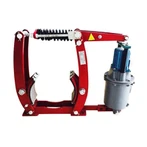
Generally speaking, there are three types of commonly used brakes, each of which has its own unique structural features and characteristics.
1. Short-stroke electromagnet double block brake
The solenoid coil is de-energized, and the main spring closes the left and right brake arms, and the two pads simultaneously brake the brake wheel, which is the braking state.
When the electromagnetic coil is energized, the electromagnet rotates counterclockwise around 0 o'clock, forcing the push rod to move to the right, so the main spring is stretched, the distance between the left and right brake arms increases, and the two pads leave the brake wheel , The brake is on.
The two brake arms are symmetrically arranged on both sides of the brake wheel, and the two pads are hinged on them, so that the positive pressure under the two pads can be equal and the closing force on the two brake arms can be equal.
Thereby eliminating the lateral force on the brake wheel. Install the electromagnet on the brake arm to make the brake stroke shorter (<5mm). The pressure of the main spring can be adjusted by a nut installed on the push rod at its end. The opening degree of the two brake arms is limited by the adjustment of the limit screw.
The advantages of this type of brake are rapid braking and flattening, small size, light weight, convenient replacement of pads and electromagnets, and easy adjustment of the gap between the pads and the brake wheel.
The disadvantage is that the impact force is large when braking, and the size of the electromagnet and the power consumption required for opening are also large.
2. Inner shovel brake.
The two brake shoes are respectively hinged with the brake bottom plate of the frame, and the brake wheel is connected with the braked shaft.
The inner cylindrical surface of the brake wheel is equipped with friction shoes made of wear-resistant materials. When the pressure oil enters the oil cylinder, it pushes the left and right pistons, and the two brake shoes press the inner cylindrical surface of the brake wheel under the thrust of the pistons to achieve braking.
When the brake is released, the pressure of the oil circuit is relieved, the spring is contracted, and the brake shoe is separated from the F brake wheel to realize the brake release.
3. Band brake.
Band brakes are braked by the friction torque generated between the brake band wrapped on the brake wheel and the brake wheel.
Under the action of the heavy hammer, the brake band is tightly wrapped on the brake wheel to achieve braking.
When the brake is released, it is realized by an electromagnet or a manual lifting hammer. The band brake is simple in structure and easy to operate. Due to the large wrapping angle, the braking torque is also large, fI! I day I brake belt wear is uneven, easy to break: the lateral force on the shaft is also large.