

1. Brake Spring - Loss of the Force Source
This is the most common and most overlooked root cause. A common site habit is "replace the friction pads, don't bother measuring the spring" - and the problem returns days later.
|
Failure mode |
Symptom |
|---|---|
|
Fatigue relaxation - preload drops year after year under cyclic load |
Works right after adjustment, starts slipping again after a while |
|
Plastic deformation - free length shortens |
Torque simply insufficient; can't recover even at the upper limit |
|
Fracture or cracks - usually at end coils / transition zones |
One-sided force, taper wear, armature tilt, sudden torque loss |
|
Unequal force across multiple springs |
Armature tilt, single-side contact, vibration and noise |
Judgement and limits:
Measure load at a specified compressed height with a spring tester; replace if deviation > 10% from standard. Without test gear, measure free length - replace if shortening > 3%–5% of original.
On multi-spring designs, replace the set as a group; never replace just one, or uneven force causes tilt.
Disc springs (caliper/disc brakes) have a finite service life - replace the full set at interval; never mix old and new.

2. Friction Pair Wear and Condition
2.1 Brake Lining (Shoe) Worn Beyond Limit
As the lining wears thin, the spring runs out of stroke and the compensation reserve is exhausted → clamping force goes to zero.
Replacement criteria (standards and OEMs vary - always follow the nameplate):
Remaining thickness < 50% of original, or absolute thickness < 3–5 mm
Rivet heads about to emerge / embedment < 1 mm → replace immediately; never let rivets contact the friction surface.
New linings must be run in: repeat light, low-load braking 20–30 times until contact area reaches 80% or more; full load must not be applied before then.
2.2 Brake Drum / Disc Damage
|
Problem |
Consequence |
|---|---|
|
Oil, grease on the surface |
Friction coefficient collapses - even a brand-new lining won't hold |
|
Grooves, cracks, flaking of hardened layer |
Uneven contact, taper wear, lining damage |
|
Out-of-round / eccentric / excessive face runout |
Single-side contact, vibration, braking force reduced |
|
Taper wear > 1.5 mm, groove depth > 0.5 mm |
Refinish by turning, or replace the drum/disc |
Tip: Fix the oil leak first, then clean the drum. Otherwise it's oily again within days. After refinishing, roughness is typically Ra 1.6–3.2.

3. Thruster / Solenoid / Hydraulic System Faults
Mechanical / fluid side
Low oil level, degraded/contaminated/emulsified fluid, air in the hydraulic system → unstable thrust, slow engagement
High fluid temperature → viscosity drops, oil film thins, seals age faster, internal leakage rises; rubber hoses crack and burst
Seized piston rod, leaking seals, seized/seized guide pins → sluggish or incomplete action
Electrical side
Low or unstable supply voltage, single-phasing → insufficient pull-in force; the spring can't reset after de-energising
Coil open / shorted / earth insulation < 2 MΩ → electromagnetic system fails
Contactor contacts welded, relay failure, lost PLC or sensor signal → no action when action is commanded
4. Thermal Fade and Overload
Frequent braking, heavy loads, poor cooling → friction material decomposes, resin carbonises, friction coefficient falls sharply; discs/drums distort from heat
Lowering a load using the shoe brake as the sole working brake → shoes carbonise. For mine hoists, combine with dynamic/low-frequency braking and keep shoe temperature below 90°C
Undersized selection: actual load inertia, duty cycle, and switching frequency exceed rated parameters - it only "just barely" works
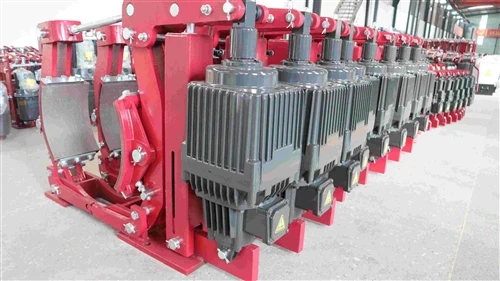
5. Causes Specific to Caliper (Mine Hoist) Brakes
Excessive residual pressure at the power pack → residual pressure directly opposes the disc springs; in severe cases the hoist won't hold at all
Cracked or broken disc springs → a sudden gap change means stop and inspect; replace the full set
Unbalanced single-drum winder adjusted with the conveyance still loaded → single-clip hoisting, braking torque halved


