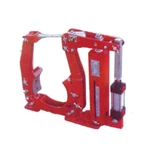
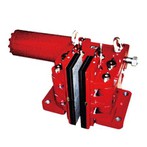
The AC motor of the electric hydraulic pusher drives the bidirectional gear pump through the coupling, and the high-pressure oil output by the gear pump enters the hydraulic cylinder through the gate block to work. The positive and negative rotation of the electric motor realizes the reciprocating movement of the piston rod of the hydraulic cylinder.
The hydraulic parts of the electric hydraulic pusher work in a closed steel cylinder oil tank, so the oil suction and return of the hydraulic system can be directly performed in the tank. The valve block is the integration of all components except the oil pump and the hydraulic cylinder, and can be designed into valve blocks of different circuit forms according to the working characteristics of the electro-hydraulic pusher.
If the hydraulic system of the electric hydraulic pusher is operated, the left side is the output of high-pressure oil, and the right side is the oil suction. The left-side system pressure is set by the overflow valve, the oil suction check valve is closed, and the bidirectional gear pump 2 outputs the high pressure to the left The oil enters the hydraulic cylinder through the check valve. At the same time, the high-pressure oil closes the throttle check valve through the control channel to ensure that the high-pressure oil enters the hydraulic cylinder.
The oil stain on the right side of the hydraulic cylinder of the electric hydraulic pusher is returned to the oil through the check valve, the check valve is closed, and the oil suction of the oil pump is completed through the check valve. If the motor is reversed, the operating state of each element on the left and right sides will follow the operating state of the symmetrical element.
In this way, the pushing and pulling actions of the electric hydraulic pusher are completed, and the external force can make the piston rod of the hydraulic cylinder move freely when the motor is powered off.