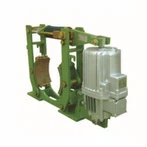
1. Working principle of drum brake
When braking, the driver stepped on the pedal, the push rod and brake master cylinder piston within the general pump the oil to a certain pressure of dirty people pump, through two piston pump brake shoe turn around the supporting pin, make the two hooves open pressure on the brake drum, at this moment, not rotate on the rotating brake drum brake shoe role a friction torque, braking torque Ml, its direction, in contrast to the direction of the rotation of the wheels, brake drum after the Mt to the torque wheels due to wheel and road surface q have adhesion effect, the wheels on the road a peripheral P, at the same time, the road is a reaction force backward, the action of the wheel braking force P,
The braking Pt is transmitted by the wheels to the vehicle frame through the bridge, forcing the vehicle to move.
When not braking, the inner circle of the brake drum and the brake shoe friction plate to maintain a certain gap, so that the wheel and the brake drum can freely rotate.

2. Drum brake:
(1) Simple unbalanced brake: This is the most common hydraulic wheel brake. In this kind of brake, the potential aid shoe, by the action of friction force, causes the pressure on the brake drum to be much greater than that on the potential reduction shoe. In order to make the two shoes wear evenly, make the potential aid shoe longer than the potential reduction shoe, so that the opening force on the shoe is not equal, but the friction moment generated is equal And achieve the purpose of uniform wear.
(2) Balanced brake: the balanced brake has two types of one-way potential aid and two-way potential aid. The one-way potential aid balanced brake has the function of automatic potential aid when each shoe is hard pressed to the brake drum, but it will become potential reducing shoe when reversing, and the braking effect is poor. Because of its large one-way braking torque, it is called one-way balanced brake. The two front and rear brake cylinders of the two-way balanced brake drive two floating brake shoes. When the forward brake is applied, all the piston of the cylinder moves outwards under the action of hydraulic pressure. Press the two shoes against the brake drum. Under the action of the friction torque of the brake drum, the two shoes rotate in the direction of wheel rotation until the support at the outer end of the piston of the two cylinder is pushed back to the end face of the cylinder. This kind of brake The actuator has good contact condition, even wear and high braking efficiency, which is mostly used by modern cars.
(3) Automatic force increasing brake: bl130 is connected by the floating adjusting rod at the lower end of the left and right shoes of the brake shoe. When the upper end of the left shoe is pressed to the brake drum by the slave pump, the opening force of the slave pump is transmitted to the lower end of the right shoe through the potential effect of the shoe, which is greater than the opening force of the slave pump. The brake torque produced by the right shoe with the same potential effect under the greater thrust is greater than that produced by the brake drum The left shoe is larger, the braking efficiency of the whole brake is higher than that of the balance type, and the device for automatically adjusting the shoe clearance is provided.

3. Advantages and disadvantages of several drum brakes:
The advantages and disadvantages of the drum brakes described above can be analyzed and compared as follows.
(1) First of all, in terms of braking efficiency, under the condition that the structural parameters are basically the same Because of the potential increasing effect on friction force, the self increasing brake is fully utilized, while the highest braking efficiency is the balance brake, and the lowest is the non balance brake. On the other hand, because the friction coefficient between the brake shoe and the brake drum itself is an unstable factor, it depends on the material properties of the brake drum and the friction plate The brake efficiency of the self increasing brake is most sensitive to the friction coefficient due to the difference of temperature and surface conditions (such as whether it is contaminated with water, oil, etc.), so it is very unstable.
(2) Drum brakes all use the friction potential increasing function to ensure a certain braking efficiency in varying degrees, but in use, because the friction coefficient is not stable, the stability of braking efficiency is poor.
(3) When the brake is working, most of the heat generated by friction is transmitted to the brake drum to raise its temperature. In order to reduce the temperature rise, the brake drum should have a large heat capacity.