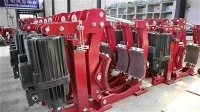
Firstly, we need to understand the reasons for the motor heating of the power hydraulic actuator that is matched with the brake. Generally speaking, the reasons for motor heating are as follows: First, the equipment is overloaded, that is, the load borne by the motor exceeds its rated load, resulting in excessive heat inside the motor and causing heating; second, the equipment has excessive friction, that is, the braking force generated by the brake during braking is too large, requiring the motor to consume more energy to overcome the friction force, thereby increasing the motor temperature; third, the equipment has poor heat dissipation, that is, the heat inside the motor cannot be dissipated in time, causing the motor temperature to rise.
In view of the above reasons, we can take the following measures to solve the problem of motor overheating when the power hydraulic actuator is working in conjunction with the brake caliper:
1. Check if the equipment is overloaded. If it is, reduce the load on the motor to keep it within the rated load range. This can be achieved by adjusting the working parameters, reducing the load, or replacing the motor with a higher power one.
2. Check if the equipment has excessive friction. If so, adjust the brake pads of the brake or replace them with new ones to reduce the friction. At the same time, check the lubrication of the equipment to ensure it is well-lubricated and minimize unnecessary friction.
3. Check the heat dissipation of the equipment. If the heat dissipation is poor, enhance the heat dissipation effect. This can be done by adding heat sinks, improving the heat dissipation environment, or enhancing the ventilation of the equipment. Additionally, regularly clean the dust and debris inside the equipment to maintain its cleanliness and ensure smooth ventilation.
In addition to the above measures, we can also take the following preventive measures to avoid the problem of motor overheating when the brake caliper actuator is working in conjunction with the power hydraulic actuator:
1. Reasonably select the power and model of the motor to ensure it meets the actual working requirements and avoid overload or overheating issues due to insufficient power or mismatched models.
2. Regularly maintain and service the equipment to keep the interior clean and well-lubricated, reducing unnecessary friction and wear.
3. Establish a complete equipment management system, standardize the usage and maintenance procedures of the equipment, and ensure its normal operation and usage safety.
In conclusion, motor heating is a relatively common problem when the brake is equipped with an electric hydraulic actuator. However, by taking appropriate measures and preventive actions, we can effectively solve this problem. During actual use, it is necessary to strengthen the daily maintenance and care of the equipment, regularly check the operation and heat dissipation conditions of the equipment, and promptly discover and solve the problems existing in the equipment to ensure its normal operation and usage safety. At the same time, it is also necessary to enhance the training and management of equipment operators, improve their professional quality and safety awareness, and avoid equipment malfunctions and safety issues caused by improper operation.
In the face of the situation where the motor of the power hydraulic actuator matched with the brake becomes hot during operation, apart from the above-mentioned solutions, there are also some other coping strategies.
Firstly, advanced thermal management technologies such as liquid cooling and heat pipe technology can be adopted. These technologies can effectively reduce the internal temperature of the motor and enhance its heat dissipation efficiency. At the same time, high-efficiency motors like permanent magnet motors can also be considered. These motors have higher working efficiency and better heat dissipation performance.
Secondly, intelligent control technologies such as temperature sensors and control systems can be adopted. These technologies can monitor the temperature of the motor in real time. When the temperature exceeds the set value, they can automatically adjust the operating state of the motor to prevent it from overheating.
Finally, it is particularly important to emphasize that for critical equipment such as the power hydraulic actuator for the brake, comprehensive inspections and maintenance should be carried out regularly. This includes checking the motor's operating status, heat dissipation, lubrication, etc., as well as performing necessary cleaning and maintenance work. Through regular maintenance and care, overheating of the motor can be effectively prevented, ensuring the normal operation and safe use of the equipment.
In conclusion, addressing the issue of motor overheating when the brake caliper is working with the power hydraulic actuator requires a multi-faceted approach, including inspecting and adjusting the equipment, improving heat dissipation, adopting advanced technologies and intelligent control, etc. At the same time, strengthening the daily maintenance and upkeep of the equipment is also very important. Only by comprehensively considering and implementing these measures can the normal operation and usage safety of the equipment be ensured.