


Hey there! As a provider of industrial disc brakes, I often get asked about how to calculate the braking distance of these essential components. It's a crucial aspect, especially for industries relying on machinery that requires precise and reliable stopping power. So, let's dive right into it and break down the process step by step.
Understanding the Basics of Braking Distance
First things first, what exactly is braking distance? Well, it's the distance a moving object travels from the moment the brakes are applied until it comes to a complete stop. In the context of industrial disc brakes, this is a key factor in ensuring the safety and efficiency of your equipment. A longer braking distance can lead to potential accidents, while a shorter one can improve productivity and reduce wear and tear on the brakes.
Factors Affecting Braking Distance
There are several factors that can influence the braking distance of industrial disc brakes. Let's take a look at some of the most important ones:
- Initial Speed: The faster the equipment is moving when the brakes are applied, the longer the braking distance will be. This is pretty intuitive - just like in a car, if you're going at a high speed, it takes more time and distance to stop.
- Mass of the Object: Heavier objects require more force to stop. So, if your machinery has a large mass, the braking distance will increase. For example, a large industrial conveyor belt carrying heavy loads will need more braking power and distance to come to a halt compared to a smaller, lighter one.
- Brake Force: The amount of force the brakes can apply is a critical factor. Stronger brakes can stop the equipment more quickly, reducing the braking distance. This is where the quality and performance of your industrial disc brakes come into play. At our company, we offer a range of high - quality brakes, such as the SB Hydraulic Clamp Disc Brake, which are designed to provide maximum braking force.
- Friction Coefficient: The friction between the brake pads and the disc is what actually slows down the equipment. A higher friction coefficient means more effective braking and a shorter braking distance. The material of the brake pads and the surface of the disc can affect this coefficient.
The Mathematical Formula for Calculating Braking Distance
Now, let's get into the math. The basic formula for calculating the braking distance (d) is based on the laws of motion. For a constant deceleration (a), the formula is:
[d=\frac{v^{2}}{2a}]
where (v) is the initial velocity of the object and (a) is the deceleration.

To find the deceleration (a), we use Newton's second law (F = ma), where (F) is the braking force and (m) is the mass of the object. Rearranging for (a), we get (a=\frac{F}{m})
So, the braking distance formula can be rewritten as:
[d=\frac{mv^{2}}{2F}]
Let's break this down further with an example. Suppose you have a machine with a mass (m = 1000) kg, an initial speed (v = 10) m/s, and a braking force (F = 5000) N.
First, we calculate the deceleration (a=\frac{F}{m}=\frac{5000}{1000}=5) m/s²
Then, we use the braking distance formula (d=\frac{v^{2}}{2a}=\frac{10^{2}}{2\times5}=\frac{100}{10} = 10) meters
Practical Considerations for Calculating Braking Distance
In real - world applications, calculating the braking distance isn't always as straightforward as using a simple formula. There are a few practical considerations:
- Dynamic Conditions: The speed and load of the equipment can change during operation. For example, a conveyor belt may speed up or slow down depending on the production requirements. You need to account for these dynamic changes when calculating the braking distance.
- Brake Wear: Over time, the brake pads will wear down, which can reduce the braking force and increase the braking distance. Regular maintenance and inspection of your brakes are essential to ensure optimal performance.
- Environmental Factors: Factors such as temperature, humidity, and the presence of contaminants can affect the friction coefficient and the performance of the brakes. For example, in a wet or dusty environment, the braking distance may increase.
Different Types of Industrial Disc Brakes and Their Impact on Braking Distance
We offer a variety of industrial disc brakes, each with its own characteristics and impact on braking distance.
- SB Hydraulic Clamp Disc Brake: These brakes use hydraulic pressure to apply a clamping force on the disc. They are known for their high braking force and quick response time, which can significantly reduce the braking distance. They are suitable for applications where fast and precise stopping is required, such as in high - speed machinery.
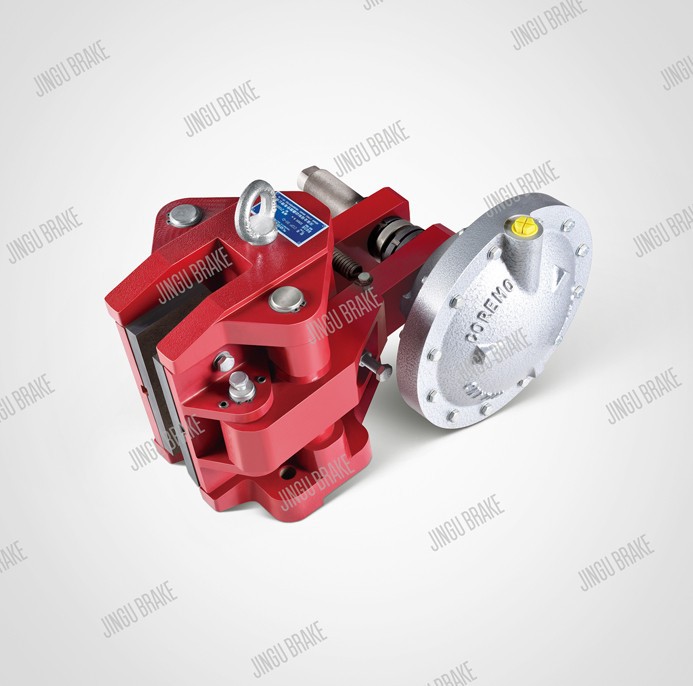
- Pneumatic Fail Safe Caliper Disc Brake: These brakes use compressed air to operate and are designed to be fail - safe. In case of a loss of air pressure, the brakes automatically engage, ensuring the safety of the equipment. They offer reliable braking performance and can be adjusted to provide the appropriate braking force for different applications, thus affecting the braking distance accordingly.
- QP/CQP SERIES CHINA PNEUMATIC DISC BRAKES: These pneumatic disc brakes are cost - effective and offer good braking performance. They are suitable for a wide range of industrial applications and can be customized to meet specific requirements, which can help in optimizing the braking distance.
Importance of Accurate Braking Distance Calculation
Accurately calculating the braking distance is crucial for several reasons:
- Safety: It helps in ensuring the safety of the operators and the equipment. By knowing the braking distance, you can set up appropriate safety margins and prevent accidents.
- Efficiency: Optimizing the braking distance can improve the efficiency of your production process. Shorter braking distances mean less downtime and faster operation cycles.
- Cost - Savings: By using the right brakes and accurately calculating the braking distance, you can reduce wear and tear on the brakes, which can save you money on maintenance and replacement costs.
Conclusion and Call to Action
Calculating the braking distance of industrial disc brakes is a complex but essential task. By understanding the factors that affect braking distance, using the right mathematical formulas, and considering practical aspects, you can ensure the safe and efficient operation of your equipment.
At our company, we're committed to providing high - quality industrial disc brakes and the expertise to help you with your braking needs. Whether you're looking for a SB Hydraulic Clamp Disc Brake, a Pneumatic Fail Safe Caliper Disc Brake, or a QP/CQP SERIES CHINA PNEUMATIC DISC BRAKES, we've got you covered.
If you're interested in learning more about our products or need help with calculating the braking distance for your specific application, don't hesitate to get in touch with us. We're here to assist you in making the right choice for your industrial braking requirements.
References
- Engineering Mechanics: Dynamics by J.L. Meriam and L.G. Kraige
- Machinery's Handbook by Industrial Press Inc.