


Hey there! As a supplier of Eot Crane Brakes, I often get asked about how to calculate the braking distance of these crucial components. It's not just a random number; it's a key factor that ensures the safety and efficiency of overhead traveling (Eot) cranes. So, let's dive right in and break down the process.
Understanding the Basics
First off, what exactly is braking distance? It's the distance an Eot crane travels from the moment the brake is applied until it comes to a complete stop. This distance is affected by several factors, including the crane's speed, the load it's carrying, the type of brake, and the friction coefficient between the brake pads and the braking surface.
Factors Affecting Braking Distance
Crane Speed
The faster the crane is moving, the longer the braking distance will be. It's a simple concept: the more momentum the crane has, the more force is needed to stop it. For example, if a crane is moving at a high speed and suddenly needs to stop, it will take a longer distance compared to when it's moving slowly.
Load Weight
The weight of the load the crane is carrying also plays a significant role. A heavier load means more inertia, which requires more braking force to stop. So, if a crane is lifting a massive piece of machinery, it will need a longer distance to come to a halt than when it's carrying a lighter load.
Brake Type
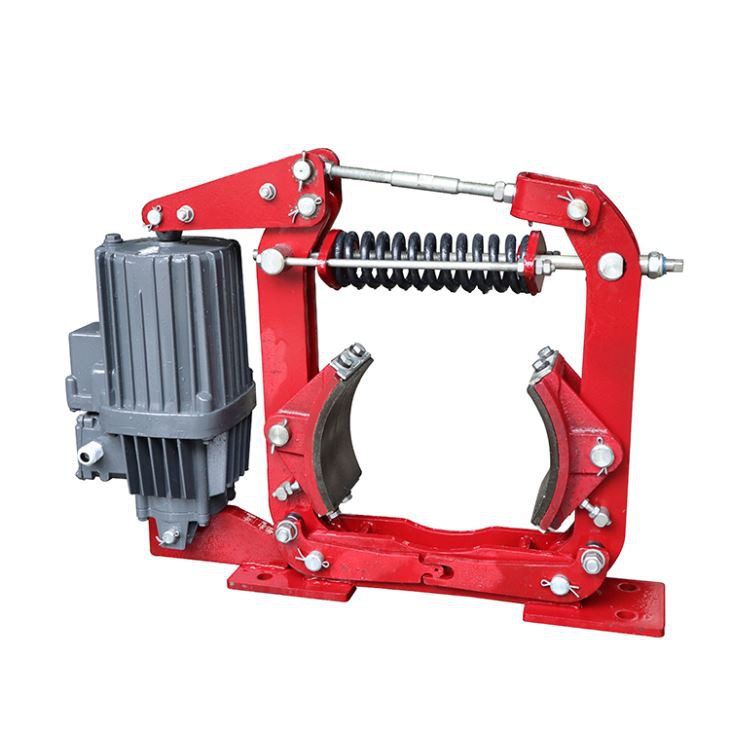
There are different types of Eot crane brakes, such as the Electro Hydraulic Thrustor Brake. Each type has its own braking characteristics and efficiency. Some brakes are designed to provide quick and powerful braking, while others are more suitable for applications where a smoother stop is required.
Friction Coefficient
The friction coefficient between the brake pads and the braking surface is crucial. A higher friction coefficient means more grip and better braking performance. However, factors like wear and tear, dirt, and lubrication can affect this coefficient. For instance, if the brake pads are worn out, the friction will decrease, and the braking distance will increase.
The Calculation Process
Step 1: Determine the Initial Speed
The first step in calculating the braking distance is to know the initial speed of the crane. This can be measured in meters per second (m/s) or feet per second (ft/s). You can use speed sensors or other measuring devices to get an accurate reading.
Step 2: Calculate the Deceleration
Deceleration is the rate at which the crane slows down. It depends on the braking force and the mass of the crane and its load. The braking force can be determined by the type of brake and its specifications. The formula for deceleration (a) is:
[ a=\frac{F}{m} ]
Where (F) is the braking force and (m) is the total mass of the crane and the load.
Step 3: Use the Kinematic Equation
Once you have the initial speed ((v_0)) and the deceleration ((a)), you can use the kinematic equation to calculate the braking distance ((d)):
[ d=\frac{v_0^2}{2a} ]
Let's say a crane is moving at an initial speed of (v_0 = 5 m/s), and the deceleration is (a = 2 m/s^2). Using the formula, the braking distance would be:
[ d=\frac{5^2}{2\times2}=\frac{25}{4}=6.25 m ]

Real - World Considerations
In real - world scenarios, there are some additional factors to keep in mind. For example, the reaction time of the operator can add to the overall stopping distance. Also, environmental conditions like wet or slippery surfaces can reduce the friction coefficient and increase the braking distance.
Importance of Accurate Calculation
Calculating the braking distance accurately is not just about following safety regulations. It can also prevent accidents, reduce wear and tear on the crane components, and improve the overall efficiency of the crane operation. If the braking distance is miscalculated, the crane may not stop in time, leading to collisions, damage to the load, or even injuries to the operators.
Our Product Offerings
As a supplier, we offer a range of high - quality Eot crane brakes, including the ELECTRO - HYDRAULIC DRUM BRAKES 14 and the YWZ8 (ED) industrial drum brake. These brakes are designed to provide reliable and efficient braking performance, helping you to accurately control the braking distance of your cranes.
Contact Us for Purchasing
If you're in the market for Eot crane brakes or need more information about calculating braking distances, don't hesitate to reach out. We're here to help you make the right choice for your crane operations. Whether you're a small - scale business or a large industrial facility, we have the products and expertise to meet your needs.
References
- "Crane Safety Handbook" by [Author's Name]
- "Engineering Mechanics: Dynamics" textbook for basic kinematic equations.